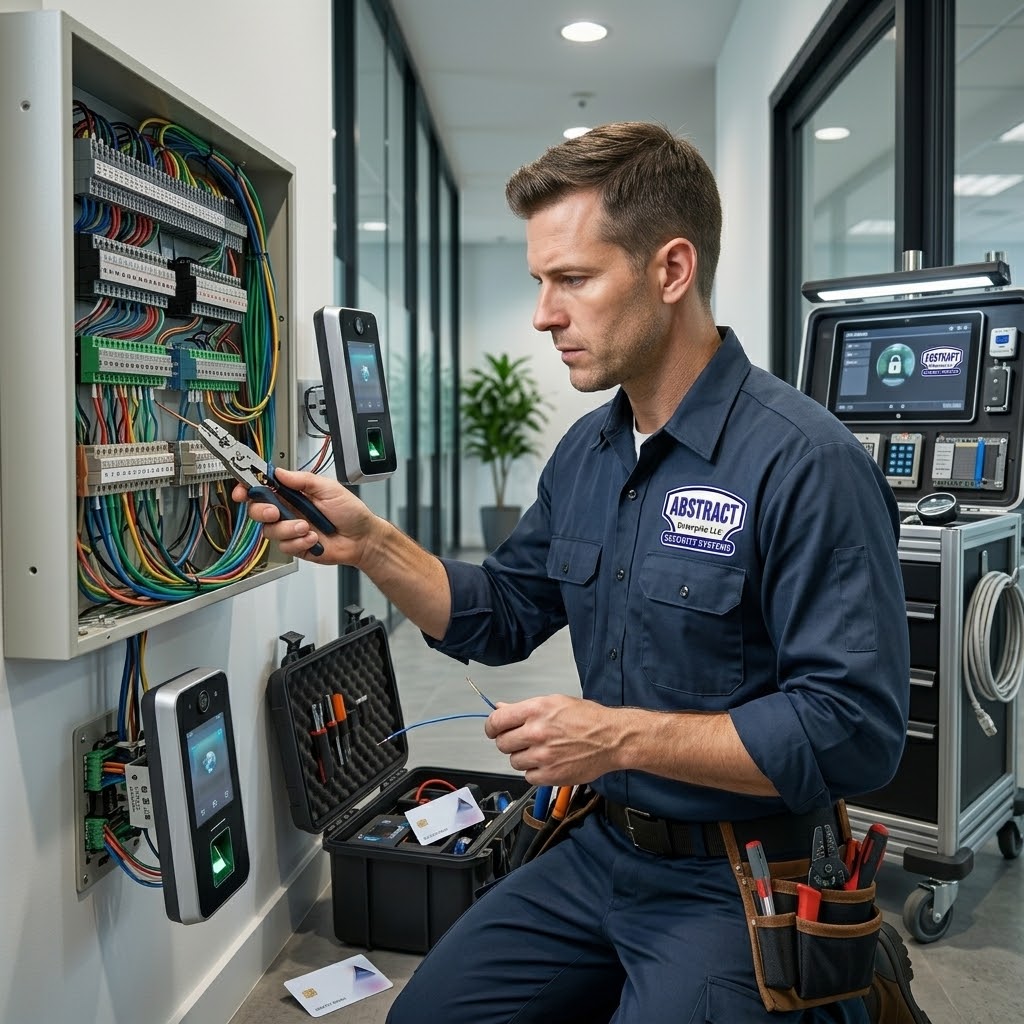
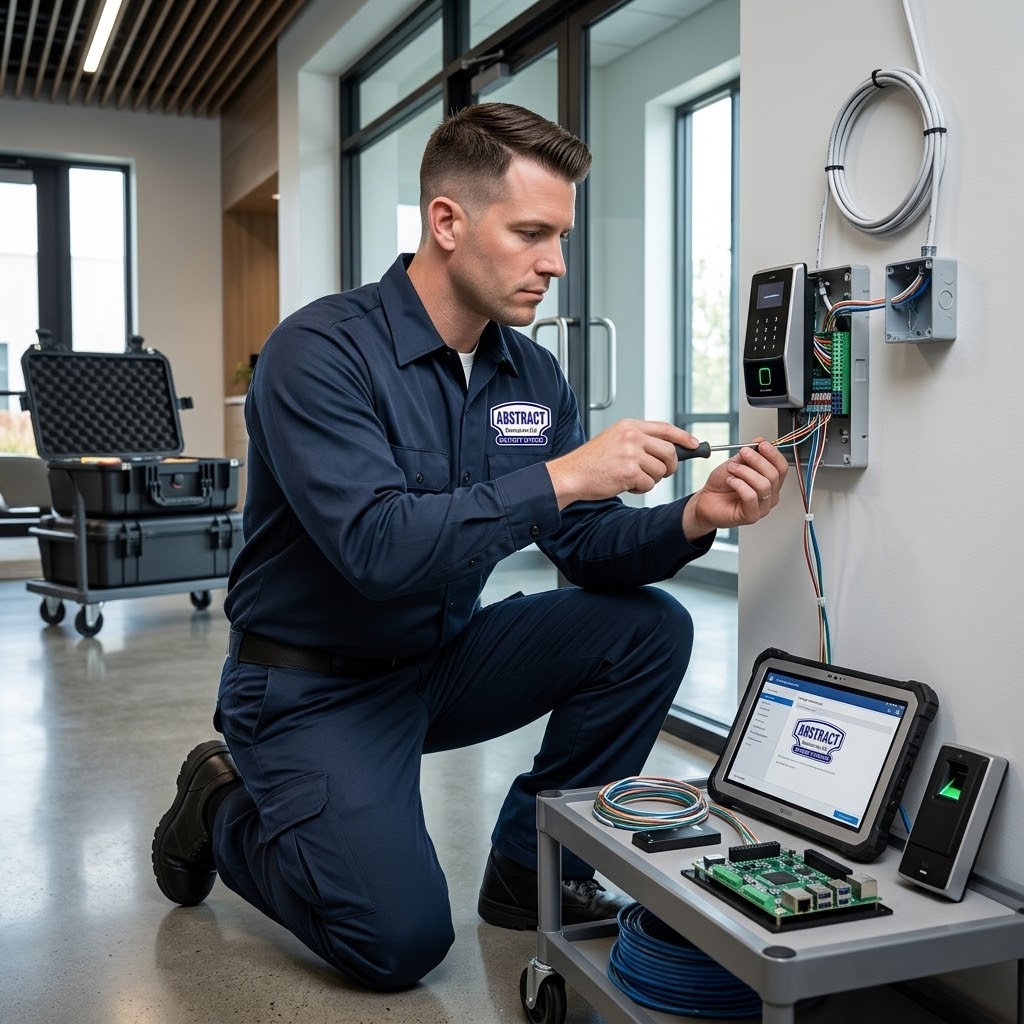
Key Fob Entry · Card Reader · Keypad · Biometric · Cloud Access · Elevator Control · All 5 Boroughs
Abstract Enterprises Security Systems is a New York State licensed access control installation company providing professional keypad entry, key fob, card reader, biometric, and cloud-based access control system installation for commercial buildings, apartment lobbies, offices, parking garages, and gated facilities across all five NYC boroughs. From a single-door keypad at a Bed-Stuy storefront to a 40-floor elevator access control system in a Midtown office tower — our certified access control installers deliver code-compliant, remotely manageable solutions with no monthly contracts required.
Every day, thousands of New York City buildings rely on access control systems that were installed a decade or more ago — systems running 125kHz key fobs that can be cloned in under 10 seconds with a device costing less than $30. When a former employee’s fob is deactivated but a cloned copy still opens every door in the building, your access control system has become a liability. Abstract Enterprises Security Systems installs and upgrades commercial-grade access control systems NYC property managers and building owners can trust — from single-door keypad entry systems in Brooklyn bodegas to multi-floor elevator access control in Midtown office towers, and cloud-managed key fob access control systems across entire apartment portfolios.
As licensed access control installers near you, we handle everything: security assessment, door hardware selection, electric strike and magnetic lock installation, card reader or keypad mounting, low-voltage wiring, panel programming, cloud software configuration, and staff training. We are NYS Licensed (#12000287431) and carry full general liability insurance. Whether you are searching for access control system installation NYC, need to upgrade key fob system from legacy credentials to encrypted smart cards, or want a complete commercial access control system with 24/7 audit logs and mobile management — we deliver professional results on schedule and within budget.
New York City’s urban density creates access control challenges that simply do not exist in suburban or rural markets. A typical 30-unit apartment building in Bushwick might issue 90 key fobs — one for each tenant plus extras for supers, management, and contractors. Each time a tenant moves out, the fob should be deactivated. But if a copy was made before they left? On a legacy 125kHz system, that cloned fob opens the lobby indefinitely — with no audit trail, no alert, and no way to know a breach occurred.
Commercial buildings face an even higher stakes environment. Law firms on Park Avenue handle privileged client files. Medical offices in Flushing store HIPAA-protected patient records. Data centers in the Bronx hold client infrastructure worth millions. A single unauthorized access event — made possible by a cloned card or a tailgating incident at an unmonitored door — can trigger regulatory penalties, civil liability, and reputational damage that dwarfs the cost of a proper access control system installation. NYC’s high tenant turnover, dense building population, and concentration of sensitive commercial uses make professional commercial access control system installation not just smart security — it is risk management.
There are also NYC-specific code considerations. Buildings over 120 feet tall require FDNY Fire Service Access Elevator designation, which intersects with how access control interfaces with elevator recall systems. Buildings undergoing DOB alterations may trigger requirements for updated door hardware meeting NYC Building Code Section 1010. NYC Local Law 127 and related accessibility requirements affect what door hardware is permissible in certain occupancy types. Working with a licensed access control company NYC ensures your installation is compliant, insurable, and built to last.
These are the citywide problems our technicians solve daily across Manhattan, Brooklyn, Queens, the Bronx, and Staten Island.
Problem: Thousands of NYC buildings installed 125kHz key fob systems between 2005 and 2018. These credentials are cloned in under 10 seconds with a $30 Amazon device. Former tenants, unauthorized sublettors, and Airbnb guests routinely duplicate building fobs. The building cannot detect cloned credentials.
Solution: Migration to 13.56MHz encrypted DESFire EV3 or HID iCLASS Seos credentials with AES-128 rolling encryption. Multi-technology readers during transition. Full credential audit and new fob issuance. Most NYC building upgrades complete in one weekend.
Problem: NYC’s non-doorman walk-up apartment buildings — the dominant building type in Brooklyn, the Bronx, Queens, and parts of Manhattan — have lobby doors propped open for hours daily. Delivery drivers, tenants, and building visitors prop doors during entry and never close them. In high-crime precincts, an unsecured lobby is a safety crisis.
Solution: Credential-controlled entry with auto-closing door hardware. Door-held-open alarms alert management when the lobby is propped for more than 30 seconds. Every entry logged with timestamp and credential ID.
Problem: Package theft is the number one property crime complaint in NYC non-doorman buildings. Delivery drivers prop vestibule doors open during bulk drops. Opportunistic theft follows within hours. NYPD data shows theft concentrated in buildings without credential-controlled entry.
Solution: Time-limited delivery credentials valid only during scheduled windows. The door locks behind carriers automatically. Residents receive push notifications on delivery entries. Buildings report theft dropping to near-zero after installation.
Problem: NYC commercial and residential towers across all boroughs have lobby access but no elevator floor restriction. Anyone inside the building can reach any floor. Law firms, medical practices, and financial offices share elevator access with unauthorized visitors who tailgate past the lobby.
Solution: Elevator floor restriction with per-credential floor profiles. Each resident or tenant reaches only their authorized floors. Visitor credentials time-limited and floor-restricted. Compatible with Otis, Schindler, KONE, and ThyssenKrupp controllers found throughout NYC.
Problem: NYC has the most landmark districts of any city in the country — Brooklyn Heights, Greenwich Village, SoHo Cast-Iron, Upper West Side, Fort Greene, Clinton Hill, and dozens more. Visible exterior hardware triggers LPC violations.
Solution: SALTO wireless electronic lock cylinders retrofit into original mortise locksets. Concealed magnetic locks mount inside. All wiring routes through interior walls. Zero visible hardware on protected exteriors.
Problem: NYC has among the highest residential and commercial turnover rates in the country. Every turnover with traditional keys requires a locksmith visit or lock change. Landlords managing multiple buildings spend thousands annually on rekeying with no guarantee all old keys were collected.
Solution: Departing tenant’s credential deactivated remotely in seconds. New credential programmed during move-in. No locksmith, no lock change, no key collection uncertainty. The system pays for itself within 2 to 3 turnovers.
Problem: NYC’s industrial corridors — Hunts Point, Maspeth, Navy Yard, Sunset Park, JFK perimeter — have loading docks that sit open during receiving hours. Multi-tenant buildings share docks with no per-tenant access segmentation. Terminated employees retain gate codes.
Solution: Credential-based dock access with anti-tailgating and anti-passback logic. Per-tenant credentials with shift scheduling. Cloud dashboard for instant revocation on termination.
Problem: NYC’s Con Edison grid experiences localized outages from aging infrastructure, summer peak demand, and construction damage. Access control systems without battery backup either lock tenants out or leave doors unsecured.
Solution: Every NYC installation includes battery backup sized to 4 to 8 hours. Egress doors configured fail-safe per FDNY. Secure-area doors configured fail-secure. Battery systems tested during installation with compliance documented per NYC Building Code.

From a single-door keypad to a 50-door enterprise system with elevator integration, remote management, and video verification — we install every category of access control system NYC properties require.
Encrypted key fob systems using 13.56MHz DESFire EV3 or HID iCLASS Seos technology. Cannot be cloned with consumer RFID tools. Instant credential revocation when a fob is lost or a tenant moves out. Time-scheduled access, floor-level restrictions, and full audit logs per credential. Replacing legacy 125kHz systems is the single highest-impact security upgrade for most NYC buildings.
Proximity and smart card reader installation for offices, co-ops, condos, and commercial buildings. HID multiCLASS readers accept both legacy and encrypted credentials during migration. Wiegand and OSDP protocol readers available. Tamper-proof backboxes for NYC public-area installations. Enterprise readers with LCD display for offices requiring visitor management.
PIN-based keypad installation for apartments, storage rooms, server closets, and retail back-of-house. Vandal-resistant stainless steel keypads rated for NYC outdoor conditions. Time-based PIN schedules let you give cleaning crews limited-hours codes without issuing physical credentials. Programmable with up to 1,000 individual PIN codes per door.
Smartphone-based access using Bluetooth or NFC. Residents and employees unlock doors with their phone — no physical fob required. Brivo, Genea, and Openpath systems allow building managers to issue, revoke, and schedule credentials from any web browser. Ideal for NYC co-ops and condos with high turnover where physical credential management is a bottleneck.
Fingerprint, palm vein, and facial recognition access control for high-security NYC applications — server rooms, pharmaceutical storage, financial back offices, and DOB-approved secure facilities. Biometric credentials cannot be shared, lost, or cloned. Integration with time and attendance systems for HR reporting.
Restrict which floors a key fob, card, or mobile credential can access. Relay interface connects to existing elevator controller dry contacts — compatible with most NYC elevator brands including Otis, Schindler, KONE, and ThyssenKrupp. Each credential gets a floor permission profile. Essential for multi-tenant office buildings where tenants should not have cross-floor access.
Vehicle and pedestrian access control for NYC parking garages. Long-range RFID readers for windshield transponders. License plate recognition cameras for contactless entry. Barrier gate interfaces, pedestrian turnstile integration, and fleet management credential profiles. Remote access management for property managers overseeing multiple garages.
Browser-managed access control with no on-site server required. Issue and revoke credentials remotely. View real-time entry logs from any device. Set time schedules, floor restrictions, and visitor codes from your phone. Brivo, Openpath, Avigilon, and Genetec cloud systems installed by our licensed technicians. Ideal for NYC property managers overseeing multiple buildings.
Migrating from legacy 125kHz to encrypted smart card or mobile credentials. Panel replacement, reader upgrade, and credential re-issuance handled as a single project. We audit your existing system, document every credential, and execute a migration plan that minimizes downtime. Most NYC building upgrades completed in a single weekend.
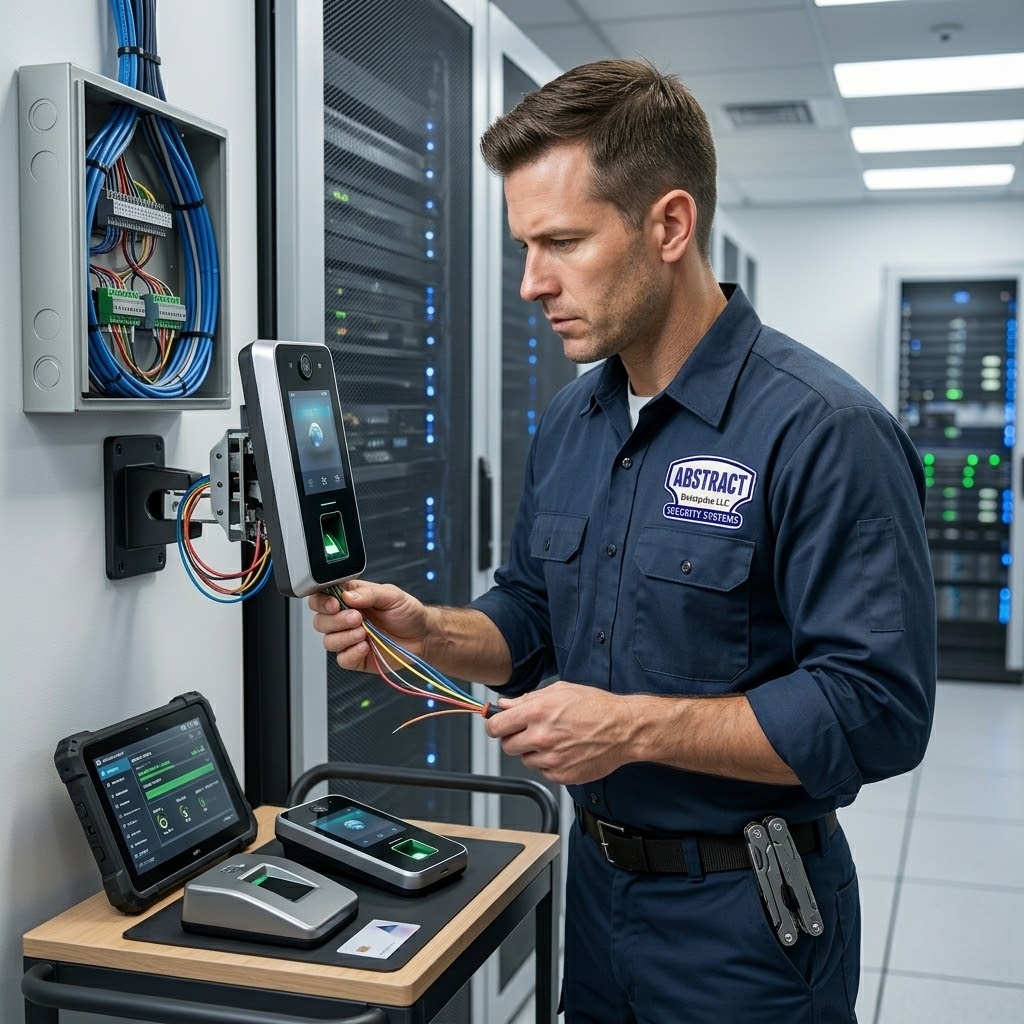
We are an independent access control installation company — not locked into any single manufacturer’s ecosystem. This means we recommend the right system for your specific NYC building type, credential requirements, and budget. Our most frequently installed brands span the full spectrum from single-door apartment solutions to enterprise multi-site platforms.
Akuvox for apartment video intercom with access control integration (widely deployed in NYC multi-family). HID Global for credential hardware and enterprise card readers. ButterflyMX for smartphone-based building entry with property management software integration. Brivo for cloud-based access control across multi-building portfolios. SALTO Systems for wireless lock solutions in co-ops and condos where hardwiring is impractical. DoorKing for telephone entry and vehicle gate systems. Aiphone for video intercom with access control at apartment lobbies. Linear for parking gate and commercial entry applications. We also service and repair Paxton, Keri Systems, GeoVision, Kantech, Lenel, Software House (C-Cure), and other legacy systems found throughout NYC’s commercial building stock.

Access control defines who can enter. But what happens after entry? A layered security strategy pairs access control installation with complementary systems to eliminate blind spots, verify identities, and create an evidence trail from the perimeter to every restricted area.
Camera mounted above every access control reader creates a visual record of every entry attempt — both successful and denied. When an access event triggers, the nearest camera automatically captures a timestamp image. Video verification dramatically reduces false disputes about who was on-site. Essential for HR and legal documentation in NYC commercial buildings.
Visitor management starts before the door opens. Video intercom stations from Akuvox, Aiphone, and ButterflyMX let staff or residents verify a visitor’s identity before granting access. Integrates with access control so approved visitors can be granted temporary credentials remotely from any smartphone. Standard configuration for NYC apartment buildings and corporate lobbies.
Access control alarm integration triggers an alert when a door is held open too long, forced open, or accessed outside scheduled hours. Integrates with your existing alarm panel or our installed Honeywell / DSC system. After-hours access attempts dispatch to a central monitoring station or generate push notifications to building management. Closes the loop between credential management and intrusion detection.
Our licensed access control technicians install and service systems in every corner of New York City. Each borough presents unique building types, architectural constraints, and tenant populations that require specific access control configurations. We understand these differences because we work in these neighborhoods every day.
In Brooklyn, we regularly install access control in Bushwick lofts converted from industrial to residential use (often requiring new door frames and strike plates), co-op buildings along Eastern Parkway in Crown Heights, retail storefronts on Flatbush Avenue, and office suites in the Brooklyn Navy Yard. Manhattan work includes elevator floor access control in Midtown office towers along Park and Lex, lobby upgrades at pre-war co-ops on the Upper West Side, law firm server room access control in the Financial District, and medical office suites in the East 70s. In Queens, we handle multi-tenant commercial buildings in Long Island City, ground-floor retail with back-office access restrictions in Flushing, and apartment lobby upgrades in Forest Hills and Rego Park. Bronx installations include warehouse and light-industrial access control in Hunts Point, school and institutional access control in Fordham, and multi-family apartment upgrades along the Grand Concourse.
Common NYC access control landmarks and corridors our technicians serve: the MetroTech office complex in Downtown Brooklyn, the Starrett City / Spring Creek Towers campus in East New York, the Hudson Yards development, the Google NYC campus in Chelsea, the World Trade Center complex, the Javits Center district, the Hunts Point Food Distribution Center, and the Roosevelt Island mixed-use development. Whether you are managing a six-unit walk-up in Astoria or a 500,000 square foot commercial building at 1 World Trade — if it has a door that needs to be secured, we can install the right access control system.

Pulled from NYC real estate forums, building manager groups, and Reddit threads. Straight answers from our licensed access control installers.
Yes — and it is the most common access control vulnerability we encounter in NYC. Legacy 125kHz key fobs have no encryption: they broadcast a fixed ID number that can be read and copied using a $20 handheld RFID device available on Amazon. The cloned fob is indistinguishable from the original in your access log. There is no alert when it is used, no flag, no audit trail difference. The only fix is upgrading to an encrypted credential system — either 13.56MHz smart cards (DESFire EV3, HID iCLASS Seos) or mobile credentials via a cloud access control platform. The upgrade typically involves replacing the reader (not the wiring or door hardware) and re-issuing credentials to all current tenants. For a 30-unit building this usually runs $3,000 to $8,000 installed — a fraction of the liability exposure from a security incident. Call (800) 486-0943 for a free assessment.
For a typical 30-unit NYC apartment building with one lobby entrance, one intercom, and a service entrance, a full migration from legacy 125kHz to encrypted smart card or mobile credentials typically costs $3,000 to $8,000 installed. This includes replacing the card readers (2–3 units), upgrading the access control panel if needed, programming new credential profiles for all tenants, and issuing new fobs or setting up mobile credentials. For commercial buildings with 10–50 doors, the cost scales to $15,000–$75,000 depending on system complexity, door hardware conditions, and whether elevator access control is required. We provide a detailed itemized quote after an on-site assessment with no obligation.
Yes. This is exactly what cloud-based access control systems like Brivo, Genea, and Openpath are designed for. All buildings are managed from a single web dashboard or mobile app. You issue credentials that work across all buildings or restrict a credential to specific properties. Real-time entry logs show you who accessed which building at what time. When a tenant moves out of one building and into another, you update their credential profile in seconds. For large NYC property portfolios, cloud access control eliminates the need for on-site visits to program or reprogram door panels. We design and install these systems with the property manager’s workflow in mind — not just the technology.
Elevator access control is one of our most requested services for Manhattan commercial buildings. The typical setup uses a relay interface that connects your access control panel to the elevator controller’s floor selection circuitry. When an employee taps their card or fob at the elevator cab reader, the system checks their credential profile and only enables the floors they are authorized for. The integration requires coordination with the elevator maintenance company to access controller wiring — we handle that communication as part of our installation service. Compatible with Otis, Schindler, KONE, and ThyssenKrupp elevators commonly found in NYC office buildings. For buildings over 120 feet, FDNY Fire Service Access Elevator requirements are maintained as part of our installation.
Tailgating is the most common access control failure in NYC lobby environments. Short of a full turnstile installation, the most effective deterrents are a door-held-open alarm (triggers an alert if the door stays open more than 5–8 seconds after a credential swipe), a camera mounted directly above the reader to create a visual record of each entry, and a vestibule with two doors in series — the inner door requires a second credential swipe so only one person can enter per authorization. A video intercom at the outer door lets reception verify visitors before granting lobby access. We configure door-held-open alerts as part of every commercial access control installation and can add camera integration to flag tailgating events in real time.
Access control audit logs are increasingly required by commercial insurance carriers, especially for properties storing financial data, healthcare records, or other regulated information. NYC commercial buildings with access control systems generate timestamped logs of every entry event — who entered, which door, at what time — that satisfy insurer documentation requirements and support forensic investigation after incidents. Installing a commercial-grade access control system with audit logging typically qualifies you for reduced premiums on commercial property and cyber liability policies. We can install a complete system — readers, electric strikes, panel, cloud management platform — and provide the insurance documentation you need. Most commercial server room access control projects run $2,500 to $6,000 installed.
This is a popular upgrade for NYC co-ops and condos. Systems like ButterflyMX, Akuvox, and Brivo allow residents to receive video calls from the lobby intercom on their smartphone and grant door access remotely. The lobby panel replaces the existing buzzer station — often using the same wiring. Residents keep their key fobs for physical entry, while the app handles visitors. Building management can issue temporary access codes for service providers and deliveries. For co-ops specifically, we work through the building’s managing agent and board to ensure the installation meets house rules and DOB requirements. Most NYC co-op lobby upgrades take one day and run $3,000 to $7,000 installed depending on building size.
Good question. A door buzzer (or intercom system) is a communication device — a visitor calls an apartment from the lobby, the resident speaks with them and presses a button to release the door. Access control is a credential-based entry system — residents and authorized users carry a physical credential (fob, card, PIN) or use a digital one (smartphone, fingerprint) to open doors without contacting anyone. Many modern systems combine both: a video intercom station that handles visitor calls AND accepts key fob or mobile credentials from residents. This hybrid approach is what most NYC buildings should be moving toward. Abstract Enterprises installs both standalone systems and integrated solutions.
Parking garage access control in NYC requires a solution that handles two very different traffic types. For vehicles, we install long-range RFID readers (typically 6–10 foot read range) that detect windshield transponders without the driver stopping or rolling down a window. For pedestrians, a standard proximity card reader or keypad at the side entrance manages foot traffic. Both credential types can be managed from the same cloud platform so a tenant can have vehicle access plus pedestrian access on a single credential profile. Barrier gate interfaces from DoorKing and Linear are compatible with most NYC parking structures. License plate recognition cameras can also be added for contactless vehicle access — no transponder required.
Yes, with the right approach. NYC Landmarks Preservation Commission (LPC) rules restrict exterior modifications to designated landmark buildings and properties within historic districts. However, access control components are typically installed on interior door hardware — the electric strike, magnetic lock, or door closer — which generally does not require LPC approval. Reader placement on existing door frames, concealed wiring through existing conduit, and flush-mounted keypad bezels can all be done without altering a building’s historic exterior. For any work that might affect exterior elements, we coordinate with your expediter or LPC liaison before installation. We have completed access control installations in Brooklyn Heights, Greenwich Village, and other historic districts without LPC violations.
Absolutely. Traditional key-based entry creates an unauditable trail: when a key is copied, you have no record. When an employee leaves, you either rekey every lock or accept that a former employee can still enter the building. For a 40-person office, a commercial-grade access control system with card readers, an enterprise panel, and cloud management software typically runs $8,000 to $18,000 installed — a one-time cost that eliminates rekeying expenses, eliminates untracked copies, and creates a complete entry audit log. Most commercial property insurance policies reduce premiums for buildings with documented access control. The ROI is typically 18–36 months depending on prior rekeying frequency.
Both are fail-safe door hardware options used in NYC access control, but they work differently. An electric strike replaces the door frame’s strike plate — when your credential is accepted, it releases the latch so the door can be pulled open. The door still looks and operates like a normal door when locked. A magnetic lock (mag lock) uses an electromagnet mounted at the top of the door frame that holds the door closed with up to 1,200 lbs of holding force. Mag locks are fail-safe (they release if power is cut) and are extremely reliable. NYC fire code requires mag lock doors to have an emergency release — typically a push-to-exit button mounted inside the door. Electric strikes are generally preferred for apartment lobby doors because they maintain a traditional appearance; mag locks are more common in commercial stairwells and server rooms where holding force is the priority.
HIPAA’s Physical Safeguards standard (45 CFR §164.310) requires covered entities to implement procedures to control and validate a person’s access to facilities and equipment based on their role. For a medical office, this typically means: access control on doors leading to patient records storage, server rooms, and medication dispensing areas; audit logs documenting who accessed these areas and when; and procedures for granting and revoking access when staff changes occur. A commercial-grade card reader system with cloud management and audit logging directly satisfies these requirements. We have installed HIPAA-compliant access control in medical offices throughout the Bronx, Washington Heights, Flushing, and Bay Ridge. We provide installation documentation suitable for your HIPAA compliance records.
Yes. For urgent security situations, we offer same-day access control installation for simple keypad and standalone reader configurations. A vandal-resistant keypad with a new electric strike can be installed at most NYC commercial doors in 2–4 hours. For networked systems requiring panel programming and cloud setup, next-day installation is typically achievable. Call us directly at (800) 486-0943 for emergency access control service — we cover all five boroughs and can dispatch the same day for urgent situations.
An access control system has four core components: a credential, a reader, a controller, and a door release device. The credential is what the user carries — a key fob, card, PIN code, smartphone, or biometric like a fingerprint. The reader is mounted at the door and receives the credential signal. The controller — a panel typically installed in a utility closet — checks the presented credential against a database of authorized users and their permission profiles. If the credential is authorized and the time is within the scheduled access window, the controller sends a signal to the door release device (electric strike or mag lock) to momentarily unlock the door. The entire transaction takes under a second. Every access event — successful or denied — is logged with a timestamp and credential ID, creating a complete audit trail for security review.
Standalone access control panels operate independently at each door — programming changes require a physical connection or proximity device. They are appropriate for simple single-door applications like a storage room or server closet. Networked access control systems connect all readers and panels to a central software platform via IP or cloud. Changes — new credentials, revocations, schedule updates — are made from any web browser or mobile app and push to all doors instantly. For NYC buildings with multiple access points, multiple tenants, or ongoing credential turnover (typical of any apartment building or commercial office), networked or cloud-based access control is strongly preferred. The management efficiency alone pays for the upgrade within the first year.
For NYC apartment buildings: ButterflyMX (lobby panel + smartphone access), Akuvox (video intercom with fob integration), or Brivo (cloud platform with multi-building management). For NYC commercial offices: Brivo, Openpath, or Genetec with HID multiCLASS readers and DESFire EV3 credentials. For high-security environments (server rooms, pharmaceutical, financial): biometric readers from Suprema or ZKTeco paired with a Lenel or Genetec enterprise platform. For budget-conscious small business: a standalone DoorKing keypad or HID VertX controller with encrypted smart cards at $1,500–$3,000 per door. The “best” system depends entirely on your building type, number of doors, credential turnover frequency, and management infrastructure — which is why we always recommend an on-site assessment before quoting.
An estimated 80% of key fobs currently in use across NYC commercial and residential buildings operate on legacy 125kHz technology — the same standard that has been in use since the 1990s. These fobs have no encryption. A handheld RFID cloner available online for under $30 can copy any 125kHz fob in under 10 seconds. The deeper problem: when a cloned fob is used, the access log records the same credential code as the original. A breach can go undetected for weeks or months. Upgrading to encrypted 13.56MHz credentials (DESFire EV3 or HID iCLASS Seos) eliminates this vulnerability entirely — these technologies use AES encryption with mutual authentication that is computationally infeasible to clone with consumer tools. This upgrade should be the first priority for any NYC building still on legacy credentials.
The invisible breach problem: 125kHz fob cloning in NYC commercial buildings. How one $30 device gives unauthorized access indefinitely — and the cloud-managed upgrade that closes the gap permanently.
How a Brooklyn co-op board eliminated physical credential management for building staff using smartphone-based access control. Supers get time-limited digital access codes instead of physical fobs that can be copied.
How a Midtown office building eliminated cross-tenant elevator access in a single weekend. Each employee’s key card now only enables the floors their company occupies — no IT changes, no hardware on every floor.
RFID card access control migration at a NYC school building. One cloud dashboard manages access for teachers, staff, and administrators. A lost card is deactivated in 30 seconds from any web browser.
After a commercial break-in, an insurer denied a claim because the policyholder could not document who had building access. The access control upgrade that made the difference on the next policy renewal.
How a door-held-open alarm and camera integration at a Bronx warehouse eliminated unauthorized tailgating through the loading dock. The system paid for itself in prevented inventory losses within 90 days.
$1,500–$4,500 per door for commercial installations. Basic apartment lobby upgrades start around $800 per door. Multi-floor elevator access control projects range from $5,000 to $25,000 depending on the number of floors and elevator banks. Call (800) 486-0943 for a free estimate.
ButterflyMX and Akuvox for buildings wanting smartphone-based lobby access with video intercom. Brivo for multi-building portfolio management. SALTO for wireless lock solutions in historic buildings where wiring is difficult. All paired with encrypted 13.56MHz credentials, not legacy 125kHz fobs.
Yes. Legacy 125kHz fobs can be cloned in under 10 seconds using a $30 device. Encrypted 13.56MHz proximity reader fobs (DESFire EV3, HID iCLASS Seos) cannot be cloned with consumer tools. If your building still uses old-style fobs, upgrading readers and credentials is the most important security investment you can make.
Yes. We integrate access control with elevator controllers from Otis, Schindler, KONE, and ThyssenKrupp. Each credential gets a floor permission profile. Tenants can only access their own floors. We coordinate with your elevator maintenance company and comply with FDNY Fire Service Access Elevator requirements.
An electric strike replaces the frame’s strike plate and looks like a standard door when locked. A mag lock holds the door closed with electromagnetic force — up to 1,200 lbs. NYC fire code requires fail-safe mag locks (release when power is cut) with push-to-exit buttons. We recommend electric strikes for apartment lobbies and mag locks for commercial stairwells and server rooms.
Yes. Interior access control components (electric strike, mag lock, card reader) typically do not require Landmarks Preservation Commission approval. We have completed installations in Brooklyn Heights, Greenwich Village, and other historic districts without LPC violations. For any work that may affect exterior elements, we coordinate with your expediter.
Akuvox, HID Global, ButterflyMX, Brivo, SALTO, DoorKing, Aiphone, Linear, Openpath, Genetec, Avigilon, Paxton, Lenel, and Kantech. We also service and repair most other brands found in NYC’s commercial and residential building stock.
Yes. For simple keypad and standalone reader installations, same-day service is available across all five boroughs. For networked systems with cloud management, next-day installation is typical. Call (800) 486-0943 for emergency access control service.
Yes. Cloud-based platforms like Brivo and Openpath manage all buildings from a single dashboard. Issue, revoke, and schedule credentials across every property from a web browser or mobile app. Ideal for NYC property managers overseeing multiple residential or commercial buildings.
Yes. HIPAA Physical Safeguards (45 CFR §164.310) require controlled access to areas containing protected health information. A card reader system with timestamped audit logs on areas holding patient records or medication directly satisfies this requirement. We provide installation documentation for your compliance records.
Door-held-open alarms, a camera above the reader, and a two-door vestibule are the most effective non-turnstile solutions. We configure door-held-open alerts on every commercial access control installation and can add real-time tailgating detection via camera integration.
All five NYC boroughs — Brooklyn, Manhattan, Queens, Bronx, and Staten Island — plus Long Island (Nassau, Suffolk) and the Hudson Valley (Westchester, Rockland, Orange, Putnam, Dutchess, Ulster).
We provide professional access control installation services across NYC, Long Island, and the Hudson Valley.
Co-ops, condos, brownstones, commercial buildings, and warehouses across all Brooklyn neighborhoods.
View Brooklyn →Office towers, co-ops, medical offices, law firms, and retail across all Manhattan neighborhoods.
View Manhattan →Multi-family buildings, commercial spaces, and institutional properties across Queens.
View Queens →Warehouses, schools, apartments, and commercial buildings across the Bronx.
View Bronx →Residential and commercial properties across Staten Island.
View Staten Island →Nassau and Suffolk County commercial, medical, and residential installations.
View Long Island →Westchester, Rockland, Orange, Putnam, Dutchess, and Ulster County coverage.
View Hudson Valley →Transparent pricing. No hidden fees. No long-term contracts. 50% deposit to schedule, balance due upon completion.
NYC sales tax (8.875%) applies · Jobs under $500 = full upfront · Over $500 = 50% deposit · Service callbacks: $195/hr, 3-hr minimum
Beyond access control, we provide a full range of low-voltage security and technology services across NYC, Long Island, and the Hudson Valley.
4K IP, dome, bullet, PTZ, active deterrent. Residential and commercial. All five boroughs.
New buzzer systems for apartments and commercial buildings. All wiring and programming.
Video, audio, and key fob intercom systems. Aiphone, ButterflyMX, Comelit, and more.
Cat6, Cat6A, fiber optic. Per-drop pricing from $175. New construction and retrofit.
Wall mounting, wire concealment, commercial displays. Homes, offices, lobbies.
Burglar, fire, wireless, commercial, smart alarm systems. No monthly contracts required.
Residential and commercial. FDNY compliant. Smoke, heat, CO detection.
You are here. Key fob, card reader, keypad, biometric, elevator control, cloud management.
Key fob programming, card reader replacement, electric strike repair, system upgrades.
Our full range of access control services includes electronic door lock replacement, key fob door entry systems, building access control upgrade, gate access control, residential access control, building security, restricted entry. We also provide perimeter security, remote unlock, security keypad, door position sensor monitoring, ADA-compliant request to exit buttons, electric strike installation, fire alarm integration — every project handled by NYS-licensed technicians from assessment through final programming.
Schedule your free access control consultation today. Same-day service available. Licensed, insured, no long-term contracts.